
Ph.D. Thesis
- Sleep mask integrating self-adaptive contactless electrodes and inertial sensors for long-term monitoring
- Maël Dengis PhD Thesis
- Hard4RadioLoc
- Integrated SPAD-based endoscopic cameras for biomedical applications
Sleep mask integrating self-adaptive contactless electrodes and inertial sensors for long-term monitoring (Laura Toussaint)
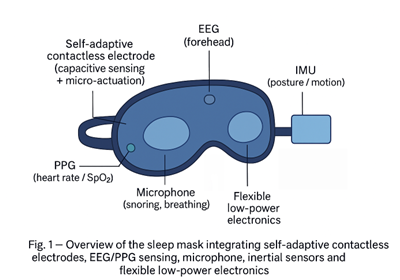
This PhD project develops a next-generation sleep-monitoring mask that integrates advanced contactless electrodes based on soft, biocompatible electroactive materials. These electrodes are designed to measure the full set of biosignals typically acquired in polysomnography (EEG, EOG, EMG, ECG) while preserving user comfort.
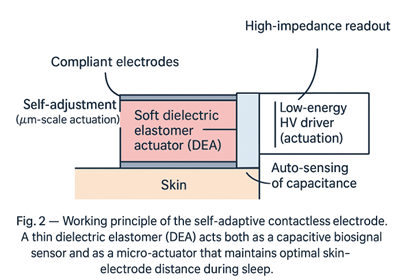
The self-sensing, self-adaptive electrodes function simultaneously as capacitive biosignal sensors and micrometric actuators. Their deformation capability allows the mask to automatically stabilise the skin–electrode coupling throughout the night, reducing motion artefacts and improving signal quality compared to conventional dry or gel-based electrodes.
The platform also integrates a microphone and inertial sensors to monitor snoring, breathing patterns, posture changes, etc. All sensing modules are embedded in a flexible, low-power electronic architecture designed for long-term autonomy and reliable overnight data acquisition. This research aims to provide a comfortable, unobtrusive and clinically meaningful home-sleep-monitoring system capable of approaching PSG-quality information without requiring a hospital environment.

Maël Dengis PhD Thesis
Thin-film transistors (TFTs) are transistors built using thin layers of semiconductor materials deposited on insulating substrates. They are already widely used in established technologies such as flat-panel displays, image sensors, and large-area electronic backplanes, where they have demonstrated reliability and cost effectiveness. Beyond these applications, TFTs are increasingly explored for flexible, wearable, and biomedical electronics requiring low power consumption and adaptable form factors.
This PhD thesis addresses biomedical monitoring applications based on TFT technologies, with a focus on the design of compact and low-power electronic circuits. The primary goal is the development of an integrated readout circuit on a flexible substrate for in-body blood pressure monitoring. Measuring blood pressure in close proximity to the heart is clinically relevant for capturing cardiovascular dynamics and requires local signal conditioning due to the weak and noise-sensitive nature of the measured signals. In this context, TFT-based flexible integrated circuits provide a suitable platform for achieving compact, low-power, and low-noise readout directly at the sensing site.
Hard4RadioLoc (Morgan Diepart)
Hard4RadioLoc is a research project supported by SDR-Engineering SRL and the SPW Economie Emploi Recherche through a Win4Doc grant.
This project consists in the development of a wideband filtering platform for use with software defined radios. This platform is designed to be used in high dynamic range environments, especially common when performing spectrum monitoring or low-power radio sources location. The goal of the platform is to attenuate the higher power signals such that they won't cause issues in the SDR receiver further down the receiver chain and as such allow the receiver to detect even lower power sources and signals.
Integrated SPAD-based endoscopic cameras for biomedical applications (François Piron)
Endoscopic surgery, also known as keyhole surgery or minimally invasive surgery (MIS) uses small incisions or natural body openings and a miniaturised high-resolution camera in order to diagnose and treat diseases.
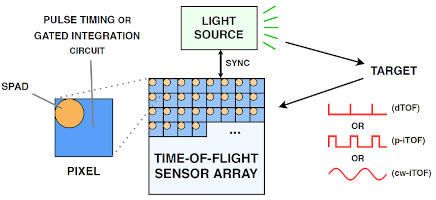
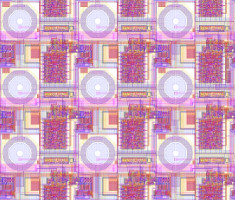
In this doctoral research, we aim to add an extra layer of information to complement the visual scene currently captured. Specifically, we target the design of a time-of-flight imager integrated circuit (IC), containing a single photon avalanche diode (SPAD) array, providing the distance between the camera and the elements constituting the visual scene, thus granting effective 3D vision to the surgeon and/or surgical robotic equipment.
Depth imagers based on SPADs usually target long-range use cases. This research aims at adapting the time-of-flight techniques to this short-range application and leverage its specific constraints to develop innovative methods and obtain a better depth resolution than what is typically presented in the literature.